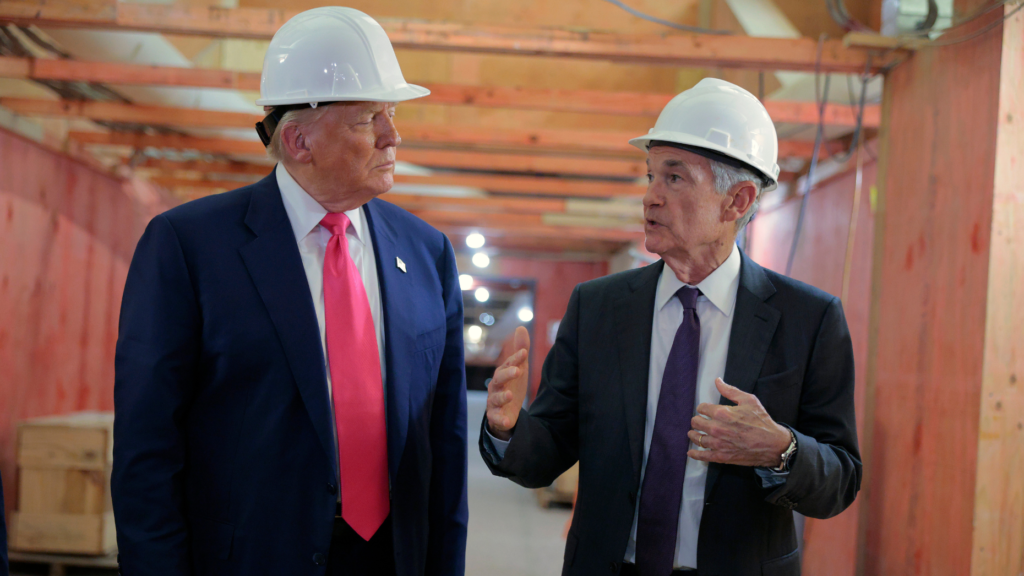

Resisting pressure from the Trump administration, Federal Reserve policymakers voted 9-2 Wednesday to hold short-term interest rates unchanged — and also cast doubts on the prospects for a September rate cut.
In leaving their target for the short-term federal funds rate where it’s been since December, at 4.25 percent to 4.5 percent, Fed policymakers indicated they’re keeping a close eye on the impact that tariffs are having on the economy.
“Near-term measures of inflation expectations have moved up, on balance, over the course of this year, on news about tariffs, as reflected in both market-based and survey-based measures,” Federal Reserve Chair Jerome Powell told reporters Wednesday. “Beyond the next year or so, however, most measures of longer-term expectations remain consistent with our 2 percent inflation goal.”
Conditions in the labor market “have remained solid,” Powell said, with employers adding 150,000 workers per month to their payrolls over the past three months, and unemployment at 4.1 percent.
But “there’s also downside risk to the labor market,” Powell said, and Fed policymakers will receive “a good amount of data” in the months ahead that will help inform future decisions about rates.
Powell explains ‘modestly restrictive’ rate stance
Fed policymakers will get “two full rounds of employment and inflation data before the time of the September meeting,” Powell noted. “We have made no decisions about September. We don’t do that in advance.”
The CME FedWatch Tool, which tracks futures markets to predict future Fed moves, showed investors think the odds of a Sept. 17 rate cut have now dropped to less than even — 45 percent — down from 65 percent on Tuesday and 95 percent on June 30.

Melissa Cohn
“The good news is that the economy is chugging along,” William Raveis Mortgage executive Melissa Cohn said in a statement. “But with inflation ticking higher, the Fed has no reason to cut rates.”
The Fed has a dual mandate — to keep as many people working as possible, without letting inflation get out of control.
While keeping rates high could slow the economy down and lead to layoffs, “Powell continues to see higher inflation as the greater risk to the economy, so it will take a couple of months to see how the new tariffs impact inflation and the Fed’s ability to cut rates,” Cohn said. “The next rate cut may not happen until the end of the year.”
Just hours before the Fed wrapped up its two-day meeting and voted not to cut rates, the Department of Commerce issued a preliminary report estimating the economy grew at an annual rate of 3 percent during the second quarter.
Q2 GDP bounces back on decline in imports
That surpassed projections for 2.3 percent growth and represented a big turnaround from the 0.5 percent drop in real gross domestic product (GDP) during the first quarter.
But economists warned that the big jump was largely due to declining imports and increased consumer spending.
That didn’t deter President Trump from claiming on Truth Social that the GDP report was “WAY BETTER THAN EXPECTED” and demanding that Powell (who Trump has nicknamed “Too Late”) lower rates.
While Trump also claimed that there’s “no inflation” and that lowering the federal funds rate would help people buy homes, inflation has been on the rise, and the Federal Reserve doesn’t have direct control over mortgage rates.
Annual inflation, as measured by the consumer price index, moved away from the Federal Reserve’s 2 percent goal for the second month in a row in June, rising to 2.67 percent.
Mortgage rates went up the last time the Fed cut
When the Fed cut the short-term federal funds rate by a full percentage point over three months at the end of last year, mortgage rates increased by an equal amount when economic reports suggested inflation was on the rebound.
Mortgage Bankers Association Chief Economist Mike Fratantoni said the MBA is forecasting that softening in the job market is likely to prompt the Fed to cut rates twice this year and one more time in 2026.

Mike Fratantoni
“Unfortunately for the housing and mortgage markets, the Fed’s actions with respect to short-term rates are likely to have little impact on longer-term rates, including mortgage rates,” Fratantoni said in a statement. “MBA’s forecast is for 30-year fixed mortgage rates to move just a little lower to perhaps 6.5 percent over the next year.”
Long-term interest rates “continue to be impacted by large deficits and debt and the growing issuance of Treasury securities to fund those deficits, which will likely keep mortgage rates near today’s level even as the Fed loosens monetary policy,” Fratantoni predicted.
Two Fed policymakers — Michelle Bowman and Christopher Waller — voted against holding rates steady, favoring lowering the target range for the federal funds rate by one-fourth of a percentage point.

Christopher Waller
Waller laid out the case for cutting rates this month in a July 17 speech, saying tariffs are “one-off increases in the price level and do not cause inflation beyond a temporary surge.”
Waller — a Trump appointee who’s seen as a potential replacement for Powell — said economic data suggests the Fed should take a “neutral” rate stance on rates that neither stimulates or restrains the economy.
Asked about the dissenting votes, Powell said that the Fed’s current rate stance is “modestly restrictive, and there are a range of views of what the neutral rate is at this moment for our economy.”
In April 2024, Bowman, also a Trump appointee, was rated by Reuters as the most “hawkish” Federal Reserve policymaker — meaning she favored keeping rates elevated to fight inflation.
Last week, Reuters rated Bowman, Lisa Cook and Austan Goolsbee among the most “dovish” Fed decisionmakers, based in part on public statements Bowman and Goolsbee have made advocating lower rates.
Get Inman’s Mortgage Brief Newsletter delivered right to your inbox. A weekly roundup of all the biggest news in the world of mortgages and closings delivered every Wednesday. Click here to subscribe.


