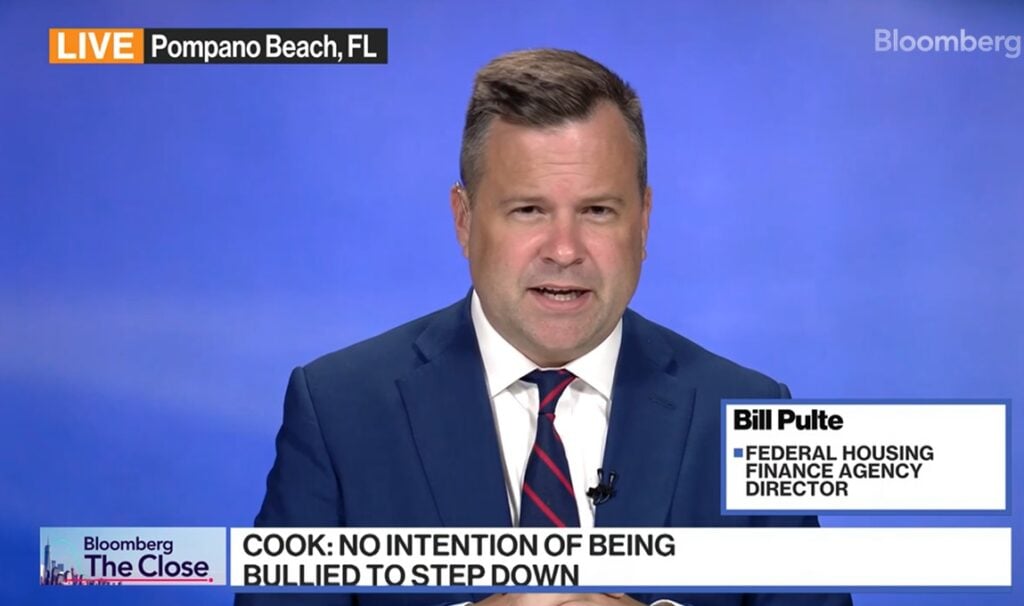

The director of Fannie Mae and Freddie Mac’s federal regulator responded to critics Thursday who have accused him of weaponizing the mortgage giants by accusing three Trump administration political opponents of mortgage fraud.
Federal Housing Finance Agency Director Bill Pulte said his criminal referral of Federal Reserve Governor Lisa Cook to the Department of Justice is part of an ongoing crackdown on mortgage fraud that will apply to anyone who breaks the law — regardless of political party or status.
Pulte’s Aug. 15 criminal referral of Cook to the DOJ for suspected mortgage fraud followed similar moves targeting Sen. Adam Schiff and New York Attorney General Letitia James. None have been charged and all deny wrongdoing, saying the allegations are political retribution.
Pulte’s critics include The Wall Street Journal’s conservative editorial board, which on Wednesday called Pulte’s referral of Cook “an ominous turn in political lawfare.”
“Weaponizing the housing regulator won’t build confidence in America’s institutions or markets,” the Journal scolded Pulte.
In an in-depth and at times tense interview Thursday with Bloomberg Television‘s Romaine Bostick and Scarlet Fu, Pulte defended his actions but declined to say whether the FHFA was receiving guidance from the White House, or whether it was investigating other government officials.
“I’m not going to be intimidated by anyone,” Pulte said. “I’m not going to be getting intimidated by the media, the politicians — they can say whatever they want. If it’s a Republican who’s committing mortgage fraud, we’re going to look at it. If it’s a Democrat, we’re going to look at it. If it’s a wealthy politician or a lawyer, we’re going to look at it.”
Pulte pointed out that Fannie Mae hired controversial Silicon Valley data analytics company Palantir Technologies in May to employ AI to help it detect mortgage fraud, which he has claimed is “rampant.”
Pulte said he sometimes makes “multiple [criminal referrals] a day, and certainly multiple per week,” continuing work with the DOJ to combat mortgage fraud that the FHFA conducted under the Biden and Obama administrations.
Pulte alleges that James, Schiff and Cook misrepresented that homes they mortgaged were their primary residences.
It’s a crime to misrepresent occupancy status on a mortgage application to obtain a better interest rate. But there are circumstances in which borrowers can claim a home as their principal residence even though they don’t live there, Fannie Mae states in its lender guidelines.
A military service member on active duty, children providing housing for their parents, or borrowers guaranteeing or co-signing a loan don’t have to live in a home in order to claim it as a principal residence, for example.
James’ attorney said Pulte cherry-picked documents when filing the criminal referral against her and ignored other records “which refute the allegations of impropriety, and make clear that a mistake on one line had no significance.”
A spokesperson for Schiff told Inman in July that lenders for homes in California and Maryland he claimed as primary residences “were well aware” that as a member of Congress, he used both homes year-round and that neither was a vacation home.
Cook, appointed to the Federal Reserve by President Biden, said in a statement that she has “no intention of being bullied to step down from my position because of some questions raised in a tweet. I do intend to take any questions about my financial history seriously as a member of the Federal Reserve and so I am gathering the accurate information to answer any legitimate questions and provide the facts.”
Pulte told Bloomberg Television that the FHFA received a tip about Cook, but would not say where it came from, or whether he or anyone at FHFA had spoken to Cook or her lawyers about the allegations.
A 2023 analysis by researchers at the Federal Reserve Bank of Philadelphia found evidence of owner-occupancy fraud in 2 percent to 3 percent of mortgage applications, down from close to 7 percent in 2006.
Owner-occupancy fraud by mortgage type

Source: “Owner-Occupancy Fraud and Mortgage Performance,” Federal Reserve Bank of Philadelphia.
That study found evidence of owner-occupancy fraud in 12 percent of private mortgage securitizations during the subprime housing boom that preceded the Great Recession of 2007-2009, and in 8 percent of “portfolio” loans not backed by the mortgage giants.
Owner-occupancy fraud is lower — around 2 percent — in mortgages backed by Fannie and Freddie (“the GSEs”) or insured by the Federal Housing Administration (FHA).
Fannie Mae and Freddie Mac have the right to demand that lenders buy back mortgages if it’s later discovered that borrowers, sellers, real estate agents, lenders or appraisers made significant “misstatements, misrepresentations, or omissions” in selling loans to them.
Income misrepresentation was the most common type of fraud uncovered on loans backed by Fannie Mae last year (46 percent), followed by false occupancy claims (29 percent), understated liabilities (17 percent), overstated assets (4 percent) and inflated credit (3 percent).
Get Inman’s Mortgage Brief Newsletter delivered right to your inbox. A weekly roundup of all the biggest news in the world of mortgages and closings delivered every Wednesday. Click here to subscribe.


