As consolidation and listing-governance questions grip the real estate brokerage world, some broker-owners have questioned whether they need to be part of a bigger network in order to survive.
But for leaders at independent brokerages, it’s mostly business as usual.
Indie broker-owners and executives in May felt largely insulated from the effects of recent consolidation and pre-marketing initiatives, and expressed confidence that no matter how things shake out, they will retain broad access to listings, according to the latest results of the Intel Index survey.
These indie leaders were also more likely than their counterparts at bigger brokerage networks to say that a consolidating industry would not harm their competitiveness in the years ahead.
Still, there is plenty of angst to go around as agents and brokers assess the landscape in a rapidly changing industry.
Intel asked more than 100 leaders at independent and big-brand brokerages how they see the year ahead playing out — and what practical strategic steps their brokerages are taking in response.
Read the findings in this week’s report.
A strategic pivot
As the industry faces more mega-brokerage mergers, pre-marketing partnership launches and even some MLS efforts to expand nationwide, many brokerage leaders surveyed said they were adjusting their strategic direction.
But just how they’re responding so far has been split.
- Leaders who were part of a big-brand network were four times as likely as indies (21 percent to 5 percent) to say their strategic response to consolidation and brokerage-controlled listing networks involved exploring an acquisition of, or merger with, another brokerage in their region.
- Big-brand brokerage leaders were also nearly three times as likely as their indie counterparts (19 percent to 7 percent) to say their consolidation response involved plans to participate in portal pre-marketing platforms such as Zillow Preview.
Instead, indie leaders were more likely than other groups to say they planned to explore joining a larger network of brokerages, or support their local MLS as it expands its national reach.
Indie broker-owners were also slightly more likely to say they planned to develop or expand their own private-listing or pre-marketing capabilities, or join a multi-brokerage alliance for listing access outside the MLS system.
But more than any other result, indie broker-owners were set apart by their determination to “double down on independence and brand recognition” in response to the recent wave of consolidation.
- 62 percent of indie broker respondents went with this option, compared to 33 percent of respondents in bigger brand networks.
Loyalty to the local MLS — with no desire for a national expansion — was most prevalent among big-brand competitors to Compass.
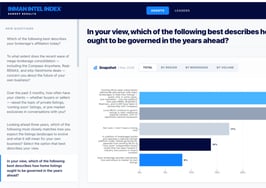
- 44 percent of leader respondents affiliated with big-brand brokerages preferred a scenario where home listings continue to be governed by local MLSs with “no significant national expansion.” That’s the highest of any group.
- Only 25 percent of indie broker-owners, on the other hand, sided with an unchanged local MLS system.
Instead, indies were more likely to favor a combination of different changes to the way the industry governs listings, including the kind of national expansion efforts announced by MLSs like MRED, BrightMLS and Realtracs in recent weeks.
- 24 percent of indie broker-owner respondents said they preferred a system where existing MLSs opened subscriptions nationwide and partnered with brokerages to feed their public and premarketed listings into the platform. That’s more than twice the share of big-brand respondents who said the same.
- Indies were also slightly more likely to favor a national MLS platform run by a coalition of brokerages, or a relatively fragmented system in which each brokerage has more control over how its own listings are marketed and displayed.
As brokerage leaders look up from this moment and ahead to the future landscape of the industry, some interesting differences — and similarities — emerge.
Where things are heading next
Most brokerage leaders don’t express a high level of concern about the recent developments in the industry — although the Intel Index did detect a decent amount of broadly shared, low-grade angst.
But indie leaders in particular are harder to pin down.
- Indie leader respondents were a bit more likely than brand-associated leaders to say they were very concerned about the trend of mega-brokerage consolidation: 28 percent among indies vs. 19 percent among others.
- But indies were also a bit likelier than big-brand leaders to say they were “not at all concerned” about the trend.
- Leaders in bigger networks, by contrast, were more likely to express a slight or moderate amount of concern with developments in industry consolidation — 53 percent of this group adopted this more measured response, vs. 39 percent among indies.
When it comes to listing accessibility in the years ahead, brokerage leaders affiliated with larger networks have pretty similar outlooks as their indie counterparts.
Generally, there are more optimists than pessimists in brokerage leadership on this question.
But there’s also a great deal of uncertainty about whether a given brokerage’s competitive position will be helped or harmed by the changes that are underway.
- 58 percent of leader respondents at big-brand brokerages said that they expected their brokerage’s competitive position would be just as good three years from now as it is today, compared to 16 percent who said they expected to be harmed by consolidation.
- Another 26 percent of big-brand respondents said they were uncertain how consolidation would impact their brokerage’s competitiveness.
Indies were even less likely to espouse a negative outlook for their competitive position.
- 62 percent of indie leader respondents said they expected no harm to their competitive position in the next three years, compared to 7 percent who thought they would struggle to compete in a consolidating industry.
- 31 percent of indie leaders surveyed by Intel said they were unsure how their competitiveness would be affected over the next three years.
Ultimately, most brokerage leaders don’t expect a doomsday scenario in which consolidation and increased brokerage control over listings will fragment the industry so deeply that their clients will be unable to access broad swaths of listings.
But in the period in between, there could be more jostling for access to bigger networks, or more powerful partnerships, as the industry adjusts to the new landscape.
Methodology notes: This month’s Inman Intel Index survey ran from May 19-28 and received 469 responses. The entire Inman reader community was invited to participate, and a rotating, randomized selection of community members was prompted to participate by email. Users responded to a series of questions related to their self-identified corner of the real estate industry — including real estate agents, brokerage leaders, lenders and proptech entrepreneurs. Results reflect the opinions of the engaged Inman community, which may not always match those of the broader real estate industry. This survey is conducted monthly.