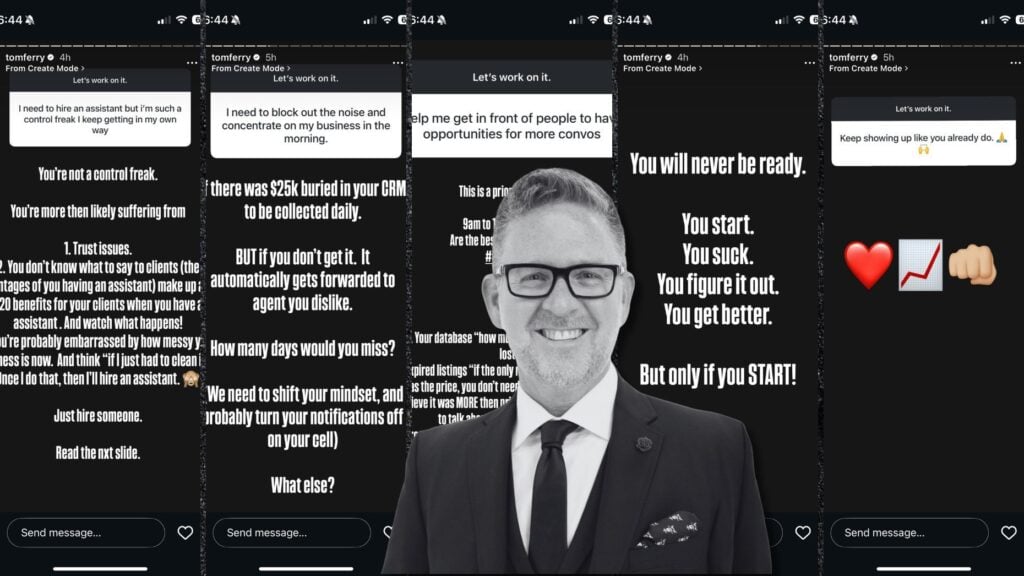

Recently, real estate coach Tom Ferry used Instagram to reveal where the agents who follow him are at mentally and emotionally as they look ahead and make predictions based on the rapidly changing real estate market. He asked his followers two simple questions:
- Will your 2026 goals require a different version of you? Ninety percent said yes, absolutely.
- What’s more likely to get you there? Here, answers vary, with 51 percent saying “systems and structure,” 31 percent saying “disciplines” and 18 percent saying “focus.”
I found this fascinating because while real estate leaders provide a lot of “happy talk” to the agents who work for them, this poll reveals that what agents want more than inspiration is implementation. Here are the actionable practices Ferry suggested in the follow-up.
The tactical blueprint: Farming for market share
Ferry delivered a two-part specific farming strategy to help agents develop a workable, replicable routine.
Farm strategy part 1: Identification
- Map your database visually using Google Maps
- Target farms with a minimum 4 percent-plus turnover
- Look for shifts in pricing and demand
- Avoid farms where a single agent dominates with more than 30 percent market share
Your goal here is to create enough value to have the remaining 70 percent choose you as their agent.
Farm strategy part 2: Communication
- Make noise early, sending three to four mailers per month to your farm
- Use curiosity-driven headlines: “Did you hear about your neighbor?” or “Equity forecast 2026”
- Outwork your listing agent competitors
- Convert open houses into launch parties and private previews
Make your brand disruptive rather than decorative.
Consistency is the currency in 2026
The most thorough list of “best practices” means nothing without consistent application of those practices. Ferry’s first implementation strategy to encourage consistency is time blocking. He suggests this sample daily schedule:
- 9 a.m. to 11 a.m. and 4 p.m. to 6 p.m.: Prospecting power hours
- One Reel a day to drive discovery on Meta platforms (Facebook and Instagram)
- 250 open houses a year
- Database calls, expired listing outreach and “just sold” neighbor conversations
More conversations translate to more opportunities, which translate to more closings. “This is just a math equation,” Ferry said.
Assuming a 4 percent conversion rate, 5,000 contacts in your database should translate into 200 sides. You can then add leverage and tools like ISAs, reviews and testimonials, content marketing and lead nurturing strategies to increase the yield, but it still starts with showing up consistently.
The $25K test: Would you miss a day?
One of the most powerful mindset shifts came from Ferry’s analogy, “If there was $25,000 buried in your CRM to collect daily, how many days would you miss?”
Even more, if you don’t collect that money, it gets transferred to the account of your toughest competitor.
When you miss a day of prospecting, you lose deals, lose momentum and lose confidence. That’s not motivational seminar-speak. It’s just reality.
Let go or get left behind
Agents in Ferry’s poll repeatedly expressed that they want help to get their business operating more smoothly and efficiently, either by taking on additional agents or by bringing in an assistant. However, they haven’t yet pulled the trigger.
What keeps people from asking for help? Ferry called out the following barriers:
- Trust issues
- Fear of providing clients to an agent who may not serve like you
- Embarrassment about a messy backend operation
Ferry’s advice? Just hire someone. Your future is dependent on your willingness to let go of control.
Start from here
Ultimately, much of Ferry’s advice boils down to: “You will never be ready. You start. You suck. You figure it out. You get better. But only if you start.”
This poll didn’t reveal a lack of awareness, and there are already plenty of strategies to follow when it comes to growing a real estate business.
Agents know they must evolve. They know discipline beats motivation. They know systems create success.
But until they start, all the strategies in the world are meaningless.
The next 24 to 36 months will belong to those who build:
- Better operational infrastructure
- Better brand presence
- Better partnerships and leverage
- Better habits
The 2026 version of you isn’t waiting to arrive; it’s being built one disciplined day at a time. The only question is, “Will you still be planning your transformation in 2026, or will you already be living it?”
Troy Palmquist is the founder and principal at HomeCode Advisors. Connect with him on LinkedIn.


