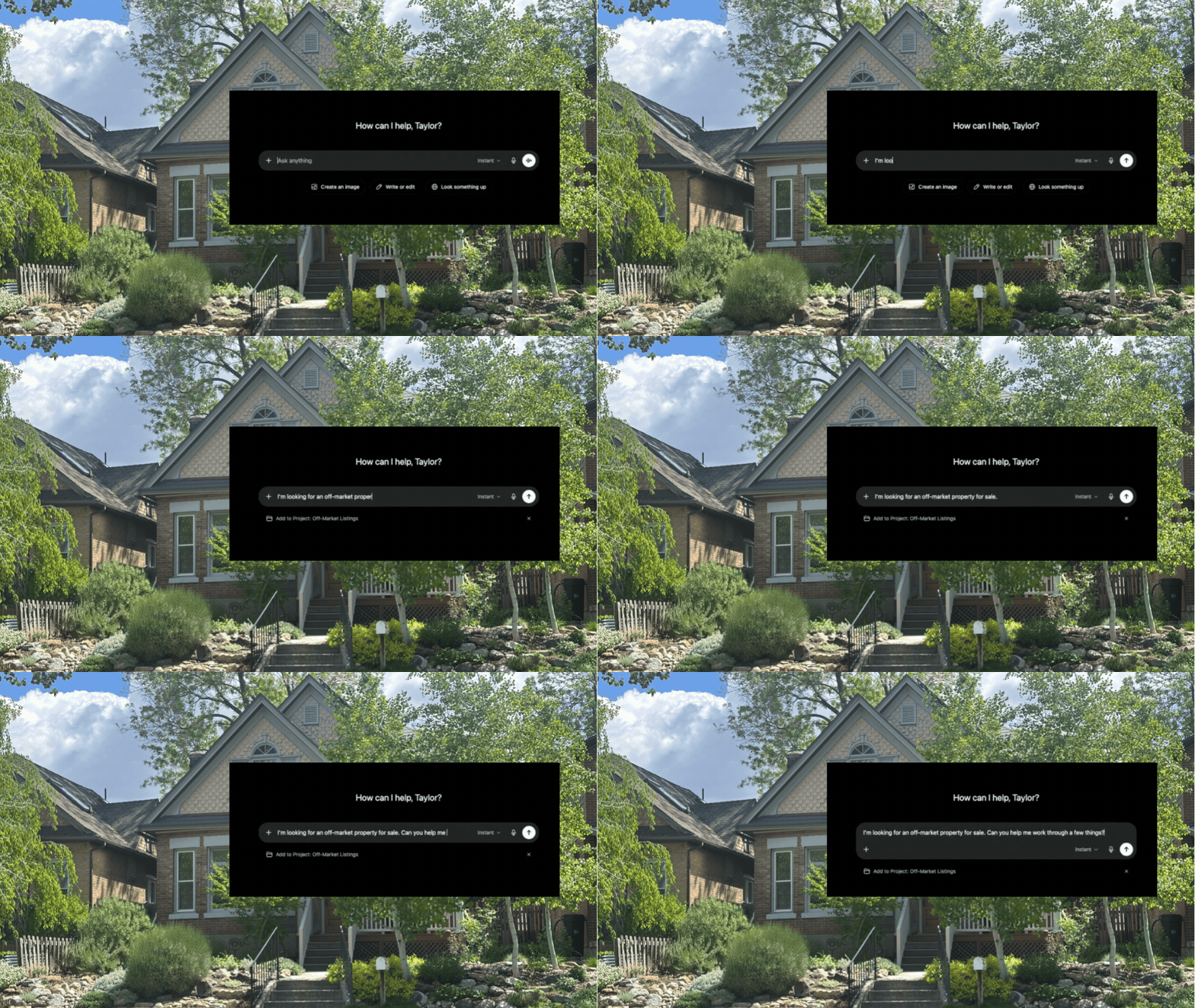

We had been waiting for a response for three months when the email I was waiting for in agony finally came.
A neighbor who was planning to sell her home agreed to show it to my wife and me.
We had heard through the grapevine that the woman down the street planned to list her home on the MLS using a real estate agent. After an email introduction, she said she was glad there was interest in her home, and that she would at least let us see it before it went on the market.
The ensuing four months gave me greater insight into the everyday work that Inman readers — the real estate professionals who run the industry — put in to make a living.
We consider ourselves some of the lucky ones.
We moved to Salt Lake City in 2017, back when it was less expensive to buy a typical home than rent one. Three years later we locked in a 2.875 percent interest rate and thought we were all set.
But after two more kids, the reality of remote work and developing a better sense for what we wanted in a neighborhood, we decided to sell our home and rent one in our ideal neighborhood.

Taylor Anderson | Inman reporter and Utah sales agent
It felt like a bet, one that made our families question our sanity. Who would trade a historically low interest rate for one starting with a 6? Why give up homeownership on a gamble?
The truth is, I knew a contingent offer wasn’t going to cut it for a bigger house in a neighborhood we hoped to stay in long-term. So we sold, stashed the equity and set off on a plan to establish ourselves as valued members of the new neighborhood.
At the same time, I set out on another journey.
On warm summer nights after putting the kids to bed, I’d come back to the office in the three-car garage and begin taking online courses to become a licensed real estate sales agent in Utah.
I was on a plane to see family in Chicago on Christmas Eve when I got the email: test passed, background check and fingerprinting completed, the Utah Division of Real Estate issued my license.
As an Inman reporter who covers the biggest brokerages in the industry, it could be a perceived conflict of interest to hang my hat at a company I might write about. So I kept my license inactive and unaffiliated with any brokerage.
By this point, my wife and I had probably visited the local MLS more than 99.9 percent of agents in all of Utah.
Around 8 a.m. in early January, a listing went live, and I called the listing agent less than a minute later.
“I didn’t even know it was live yet,” the agent told me. It was a phrase I’d go on to hear from three other agents within just a few weeks.
I’ve heard agents compare the late-winter, early-spring market in Salt Lake City to the heyday of the COVID housing market. Houses would list on Thursday, there may or may not be an open house, the description would be updated mid-weekend with that familiar phrase: “MULTIPLE OFFERS. HIGHEST AND BEST DUE MONDAY.”
With each house, I would play a combination of agent, homebuyer and investigative reporter.
I’d run the house through my own due diligence checklist, checking permit history, zoning, sewer lateral age and ownership. Then I’d call and pick up even more information from the listing agent.
It might have felt like a game if I weren’t looking for a forever home to raise my kids in, and with a self-imposed June 1 deadline to get it done before our lease expired or we’d be locked in for another year.
In total, I made four offers, some of them well above asking and each optimized with the seller’s desires in mind, before I learned why it wasn’t working.
A key to my strategy of competing — and winning — in a hypercompetitive market was that I wasn’t asking for any buyer agent compensation. If I was going above asking and tacking on another 2 percent to 3 percent for the seller’s profit, I thought, I’d win for sure.
After the fourth loss, I pieced it together.
As an unrepresented buyer, I was a perceived risk to the seller and a likely future headache to the listing agent. Besides, the sellers likely agreed to give more compensation to their agents if the buyer was unrepresented.
So while I was treated seriously and respectfully throughout this process, I was losing. And as a competitive person with a real deadline approaching, I needed to shift my approach again.
We briefly worked with a discount broker for two reasons.
First, with two of the houses we made offers on, I would have needed to add a basement apartment to be able to stomach the monthly payments. (Remember, we were taking swings to hit a homer and level up into a forever home.) Getting a check for 1.5 percent of the home price would have helped me achieve that.
Second, I really did want to experience this as an agent. I found someone who inherently took care of my BAC problem and also appreciated that I was ready, willing and able to carry my weight through the transaction.
We made one offer with that agent — who was terrific to work with — before lightning struck.
After three months of relative silence from our neighbor, she opened the door.
I mean that literally.
She had been traveling and completely unreachable for a time, then going through a period of deep grief from the loss of a loved one.
All the while she was contemplating.
She’d sold homes on-market and off-market before. While preparing to sell this home, she met with three agents. She didn’t “vibe” with any of them, she said, while talking with us in her living room in April.
She had decided she was open to offers, that she wasn’t going to use an agent, and she gave us her price range.
Having been embedded in the neighborhood, I knew her range was solid. I also knew that if she put the house on the market, a frenzy would ensue, and we likely would lose.
By that point, the transaction no longer felt entirely transactional.
We spent nearly two hours walking through the home while she told stories about the property, the landscaping and the decades of life that had unfolded there. She talked about wanting children in the home again. She talked about neighbors and community. She appreciated knowing who would live there, not just what they would pay.
And all the while I was using the chatbot of my choosing (at the time, ChatGPT), which played part strategist, part guidance counselor throughout the entire process.
The bot advised patience at times when I would have otherwise had none.
It helped me workshop delicate emails and texts to avoid sounding overly aggressive or transactional while still moving the deal forward. It helped me think through timing, financing structures, appraisal risk and possession dates.
When rate sheets came in, the bot would analyze the short- and long-term impact of each option. It would double-check documents before they were sent and signed. At one point, it even helped us sequence a move across the street with two young kids and effectively no room for error.
Most interestingly, the bot often slowed me down rather than speeding me up.
There were moments when I wanted to push harder for answers, follow up again or force clarity around timing. Instead, the chatbot repeatedly advised restraint, patience and collaboration.
That turned out to matter.
The seller eventually accepted our offer with a clean and straightforward process that worked for her.
The inspection went smoothly. The seller proactively offered to pay for radon mitigation if elevated levels were found. We coordinated directly on possession timing, title and moving logistics. The final agreement gave her several days after closing to finish packing and loading movers before possession transferred to us.
I didn’t trust the bot to analyze pricing. At least for now, it doesn’t have access to the most accurate data that would help it nail down numbers I would trust. Those only come from the MLS.
And despite how this story may sound, ChatGPT did not replace the role of a real estate professional.
I still had to:
- evaluate risk
- build trust
- coordinate timelines
- understand contracts
- communicate clearly under pressure
- and make judgment calls with real financial consequences.
What changed was that I effectively had a continuously available strategic sounding board helping me think through every step of the process.
There may be some of you who think the seller and I each made a series of mistakes.
Maybe she could have gotten more if she had worked with an agent. Maybe I overpaid. Maybe both of us took on unnecessary risk.
All I know is that documents have been signed, closing costs paid, we’ve funded and recorded, and I’m writing this from my dream home.
The future is here. Agents should take note.